Atlas Runtime Governance
Runtime Intelligence & Investigation Infrastructure for Robotics
Designed for robot OEMs and sensor manufacturers, Atlas continuously observes the runtime environment between sensors and SBCs. It transforms fragmented, ephemeral, and hard-to-reuse data into investigable evidence, reusable knowledge, and continuously growing organizational capabilities.
From before deployment to after deployment.
Observe. Understand. Investigate. Improve. Reuse.
Atlas does not replace ROS 2, sensor drivers, Fleet Management, ticketing systems, or existing R&D toolchains.
Atlas builds the missing layer in the robotics industry:
Runtime Sensor Governance Infrastructure™
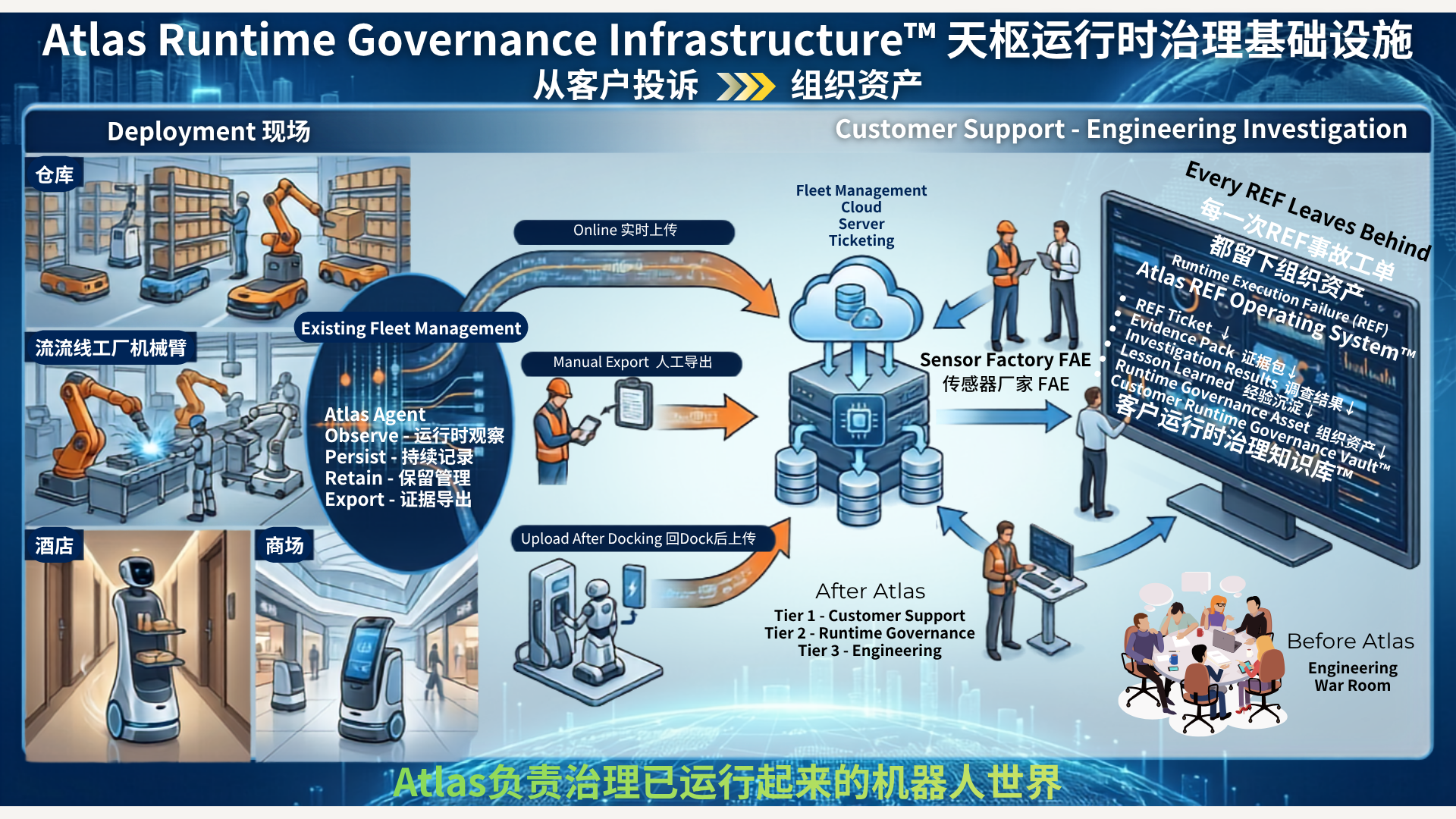
The Real Problems Begin After Robots Enter the Real World
Once deployed, robots continuously face runtime dynamics that can hardly be fully covered in R&D environments:
- Diverse lighting, reflection, occlusion, temperature, vibration, and humidity conditions
- Varying power supply quality, wiring harness states, bus loads, and communication environments
- Combinations of different Linux, Driver, Firmware, ROS, and Host Platforms
- Diverse Robot SKUs, Sensor SKUs, and deployment scenarios
- Varying operational habits, maintenance conditions, and system loads across customer sites
The same robot model, same sensor model, and same software stack can exhibit completely different runtime behaviors across different operational sites.
What is truly expensive is not just a single runtime execution failure.
What is truly expensive is:
Every Runtime Execution Failure (REF) requires collecting logs from scratch, re-interpreting the site, re-discovering evidence, and troubleshooting all over again.
Once an investigation is completed, the lessons learned remain scattered across tickets, emails, chat logs, local PCs, and individual memory.
When a similar incident occurs next time, the organization starts from square one again.
Atlas Turns One-Off Troubleshooting into Sustainable Governance
Atlas organizes runtime events into a complete evidence and knowledge chain:
Atlas Agent
    ↓
Observe
    ↓
Persist
    ↓
Retain
    ↓
Evidence Pack
    ↓
Historical RGA Recall
    ↓
OEM / Sensor Investigation
    ↓
IR (Investigation Result) / LL (Lesson Learned)
    ↓
Assist Vault (Runtime Knowledge Asset Library)
    ↓
Future REF Reuse
Atlas does more than just help teams close a ticket.
Atlas ensures that every investigation generates new organizational assets and serves as the starting point for the next one.
Core Value of Atlas
Evidence-Driven, Not Driven by Opinions
Atlas organizes runtime data before and after an anomaly into a unified Evidence Pack.
Teams conduct investigations around a single piece of evidence with defined time windows, sources, boundaries, and integrity records, rather than arguing back and forth over different log versions.
Historical First, Never Start from Zero
Every REF prioritizes recalling Historical RGA (Runtime Governance Analysis/Asset).
The investigation team can refer to previously completed:
- Investigation Result
- Lesson Learned
- Investigation Path
- Excluded Path
- Runtime Pattern
- Recovery Pattern
- Why Retrieved
Historical cases do not automatically become the root-cause conclusion for current incidents, but they provide engineers with faster, bounded investigation entry points.
Cross-Team Collaboration, Unifying Investigation Context for OEMs and Sensor Vendors
Atlas establishes a unified evidence and investigation context across OEM Tier 1, Tier 2, Tier 3, and Sensor FAEs.
OEMs no longer send fragmented logs to sensor vendors.
Sensor FAEs no longer guess what happened on site from scratch.
Both sides collaborate around the exact same REF, Evidence Pack, and historical context.
Reusable Knowledge, Continuously Appreciating Engineering Experience
After an investigation concludes, IR, LL, and RGA are saved in a structured manner.
New investigation results can serve:
- The next REF
- The next Robot SKU
- The next Sensor SKU
- The next Host Platform
- The next deployment scenario
- The next customer project
Atlas turns one-off engineering costs into sustainably reusable organizational capabilities.
Your Data, Your Control
Customer raw data, Evidence Packs, and internal investigation assets remain under customer control at all times.
Atlas supports private deployment, retention policies, export policies, access boundaries, and anonymized reuse.
What is shared is not customer data.
What is shared is authorized investigation capability and organizational experience.
Cross-SKU, Cross-Platform, Cross-Scenario
Atlas is not a piece of project-based glue code written for a single robot, single sensor, or single customer issue.
Using a unified Runtime Governance Model, Atlas maintains a consistent evidence structure, investigation process, and historical asset model on top of product differences.
Cross-Robot SKU
The same OEM can gradually scale to different robot models without building a new investigation system for every SKU.
Cross-Sensor SKU
The same sensor vendor can manage diverse products such as LiDAR, Camera, IMU, GNSS, and Radar under a unified governance framework.
Cross-Host Platform
Atlas adapts to x86, NVIDIA Jetson, ARM SBC, ROS 2, and custom customer runtime environments.
Cross-Deployment Scenario
Restaurants, hotels, hospitals, shopping malls, warehouses, factories, and outdoor environments can share a unified governance framework while retaining their respective Runtime Profiles and Investigation Contexts.
Atlas’s goal is not to add another script to every project.
Atlas’s goal is to empower the entire organization with a continuously scalable runtime governance infrastructure.
Two Product Lines, One Governance Platform
Atlas Runtime Sensor Governance™
For Sensor Manufacturers
Empowers Sensor CTOs, FAE Leads, Firmware, Driver, Validation, and Product Teams to build runtime governance capabilities across OEMs, products, and scenarios.
Key value includes:
- Establishing Sensor Runtime Profiles
- Accumulating Historical Sensor RGA
- Improving FAE investigation efficiency
- Unifying OEM collaborative investigation materials
- Reusing investigation experience across customers and projects
- Turning field issues into product improvement inputs
Atlas Runtime Investigation™
For Robot OEMs
Empowers CTOs, Engineering VPs, Tier 1, Tier 2, Tier 3, and Customer Support teams to build a standardized, operable, and measurable runtime investigation system.
Key value includes:
- Unifying runtime evidence
- Shortening Investigation Time
- Reducing repetitive Tier 3 workload
- Increasing Historical RGA Reuse
- Establishing an enterprise-grade Assist Vault
- Making every REF yield long-term value
Why Different Roles Need Atlas
CTO / Engineering VP
Atlas transforms runtime investigation from invisible engineering overhead into measurable governance capabilities.
Management can continuously track:
- REF Trend
- Median Time to Closure
- Historical RGA Reuse
- Tier 3 Involvement
- Sensor FAE Response
- Engineering Cost
- Cross-SKU Expansion
- Governance ROI
OEM Tier 1
Tier 1 can process event intake and escalation using unified Intake and Evidence References, no longer relying on free-text descriptions or ad-hoc screenshots.
OEM Tier 2
Tier 2 can start investigations with complete Investigation Context and Historical RGA, reducing time spent on log aggregation, time alignment, and repetitive troubleshooting.
OEM Tier 3
Tier 3 engages only in the few incidents that truly require deep engineering judgment, rather than being bogged down long-term by evidence gathering and redundant analysis.
Sensor CTO / FAE Lead
Sensor vendors can conduct investigations around a unified Sensor Engagement Pack, building Sensor RGA that is sustainably reusable across OEMs, SKUs, and projects.
Sensor FAE
FAEs can work with explicit time windows, Runtime Surfaces, OEM Contexts, and historical investigation paths, no longer having to decipher customer sites from scratch.
Runtime Boundaries Guarded by Atlas
Atlas focuses on the boundary within robotic systems that is most easily overlooked yet sees a high incidence of runtime issues:
Sensor
    ↓
Power / Bus / Timing
    ↓
Linux / Driver / Buffer / Scheduler
    ↓
SBC
    ↓
ROS Topic / Application Input
Atlas continuously observes and organizes:
- Sensor Runtime
- Power
- USB / Ethernet / CAN / CSI
- Trigger / PPS / Timing
- Linux Runtime
- Driver
- Buffer / Scheduler
- ROS Topic
- Application Input
Atlas does NOT:
- Automatically confirm Root Causes
- Automatically assign liabilities
- Automatically generate final Investigation Results
- Replace engineers in making final technical judgments
Atlas is responsible for organizing evidence, recalling history, establishing context, and narrowing down the investigation scope.
IR and LL are always completed by authorized engineers.
From Pilot to Enterprise Infrastructure
Atlas is delivered through enterprise-grade customized engagements.
The typical path is:
Pilot
    ↓
Controlled Deployment
    ↓
Production Readiness
    ↓
Cross-SKU Expansion
    ↓
Organization-wide Runtime Governance
Atlas can start from a single Robot Model, Sensor Product, or high-frequency REF scenario, and gradually expand to:
- More Robot SKUs
- More Sensor SKUs
- More Host Platforms
- More customer sites
- More investigation teams
- More comprehensive Historical RGA
- More mature organizational governance metrics
The Ultimate Goal
The ultimate goal of Atlas is not just closing an incident faster.
Atlas aims to help robotics companies and sensor manufacturers build a new organizational capability:
Every REF starts from history.
Every new case enhances future capability.
Every investigation makes the entire organization stronger.
Engineers continue to create new robots, sensors, and products.
Atlas continuously observes runtime, organizes evidence, preserves history, and enables past engineering experience to continuously generate new value.